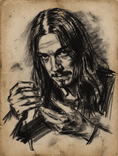
The abbot versus the machine
In 1492, Johannes Trithemius, abbot of Sponheim, received a request from a fellow abbot, Gerlach of Deutz: could he think of something to coax the brothers into taking up the pen more often? Trithemius was not one for the curt reply. He sat down and wrote a treatise, In Praise of Scribes.
Books were already pouring off the presses by that point. Forty years before the two abbots corresponded, Johannes Gutenberg had set up shop in Mainz, and living scribes had acquired an efficient, high-tech rival.
The newfangled printed book pleased Trithemius far less than the handwritten one. Paper, by his reckoning, would last two hundred years at the very best; a good old book on parchment could endure a thousand. Nor did his objections stop at the material. Some printed editions, he noted, limped in their spelling and were careless in their ornamentation.
Scribes, the abbot also explained, lend strength to words and memory to concepts. A monk bent over a manuscript is, at the very least, not idle, and a scribe with nowhere to go in a hurry imprints what he writes more firmly on his mind.
He saved his sharpest point for chapter seven.
"Brothers, no one should think or say "Why do I have to wear myself out writing by hand, when the art of printing has brought so many books to light, so that we can cheaply put together a great library?" Truly, whoever says this is trying to conceal his own sloth."
— Johannes Trithemius, De laude scriptorum, ch. 7, 1492, trans. Dorothea Salo (CC BY 3.0 US)
The world has not changed much since.

The same complaints, five centuries on
Five hundred years have slipped by, and the catalog of grievances against new technology has scarcely changed.
Print, Trithemius lamented, drags the standard down, turning out books cheaply and with gross carelessness. AI stands accused of the very same sins today. The Authors Guild complains of bookstores clogged with LLM-generated titles, and Kyle Chayka, in The New Yorker, calls AI a technology of averages: it simply produces the most statistically probable string of words.
The abbot held that whatever a person writes down himself lodges more firmly in memory than information he merely reads. An MIT experiment points to the same phenomenon, though its numbers are too thin to bear much weight (a preprint notes 54 participants). Among those who worked with ChatGPT, 83 percent could not quote their own text. In the control groups, where people wrote without AI, only 11 percent drew a blank.
Sloth, of course, has weathered the centuries remarkably well. The sort Trithemius warns of has even acquired a scientific name: metacognitive laziness. The term came out of an experiment that asked 117 students to revise essays (peer-reviewed, British Journal of Educational Technology, 2025). Some used ChatGPT, some had a human instructor, some had a checklist, and some worked alone. The essays improved most in the ChatGPT group, but those students barely checked or weighed their own work, unlike the ones guided by an instructor or a checklist. The algorithm had spared them the effort of writing, and so they pulled ahead of no one, either in what they learned or in how well they could apply it to new problems. The authors are careful: AI, they say, may nudge people toward this kind of laziness.
Incidentally, the abbot scolded more than the printing press. Lazy scribes drew just as much of his wrath: those who worked half-heartedly made errors and mangled texts. Manual labor, in his eyes, was not its own absolution. What mattered was that the text of a book be correct and that real, thoughtful effort go into it. Diligence and a good result counted for more than the method of production.
In praise of parchment, printed on paper
This story gets awkward. Trithemius sent his treatise defending the copyist to a printer. Peter von Friedberg produced it in Mainz, the very city where Europe's first press had clattered to life. Thirty-five copies survive. Not one is on parchment.
The abbot was no enemy of print. Quite the opposite: he used it gladly. During his tenure, the Sponheim library swelled from a few dozen volumes to two thousand, many of them printed. His own works were issued some thirty times in the fifteenth century. Even in chapter seven, he does not call for smashing the presses; instead he writes that even printed books deserve to be copied by hand, or they will not last.
He is in good company in this inconsistency. Plato disparaged writing, and we know it only because he wrote his objections down. Trithemius did exactly the same, entrusting the defense of manual labor to the printing press.
The abbot leaned on an important principle: whatever forms you, do not hand over to the machine. This fall, the University of Chicago adopted the same rule for its core social science courses, where AI is now banned.
"We first equip students to read, write, and think without dependence on AI."
— Jenny Trinitapoli, memo to SOSC Core chairs, Aug. 1, 2026, University of Chicago Social Sciences Collegiate Division
Still, the printing press did destroy some people.
Who went under and who landed on their feet
People still copied church texts by hand in the seventeenth century, and wrote business papers that way until the typewriter came into general use sometime after 1860. By the end of the sixteenth century, though, hand-copied books had almost gone extinct. So had scribes.
This is the ordinary fate of any profession that rests on a single narrow function. The traffic officer who stood in the middle of an intersection, signaling who could go and who had to wait, almost disappeared once the traffic light became popular in the 1920s. The elevator operator pressed a button and carried passengers to their floors; of the 270 occupations in the 1950 U.S. census, his was the only one to vanish because of automation. The telephone operator plugged cords into the jacks of a switchboard. At mid-century there were about 342,000 of them in the country. By 1984, 40,000 remained.
None of this happens overnight. Telephone operators held their posts for decades, serving as living voice assistants. Automation rarely erases a profession whole; more often it carries off individual tasks.
Monks are pursuing a vocation, though, rather than a profession. Even in the fifteenth century, copying was only one of their many daily tasks. No other kind of manual labor suits a monk better, Trithemius wrote: they can always find time for the pen, so it doesn't interfere with the Divine Office.
Even so, some monks mastered the new technology. The Serbian abbot Mardarije traveled to Venice in 1543 to get a press for the monastery of Mileševa. A year later, together with Teodor Ljubavić, he prepared the first Mileševa Psalter for printing. At the Benedictine abbey of Subiaco, two German clerics opened the first printing house in Italy.
Other former scribes turned to broader scholarship. The French Maurists made learning the chief work of their congregation, and in 1681 Jean Mabillon laid the foundations of diplomatics and paleography, helping people tell a genuine charter from a forgery.
Those who adapt to advances can go down in history. We're less likely to remember those who just drop out of the field.
The new scribes
AI has not yet killed writers and editors. Like monks, they have plenty to do besides setting down text. The trouble falls on those whose work fits inside a single act, such as interview transcribers: while software isn't always better for the task, it's generally faster and cheaper, and the market usually finds that sufficient. As early as 2025, the U.S. Bureau of Labor Statistics named transcribers (medical ones, admittedly) among those AI would hit first.
Transcribers today have two roads. They can remain transcribers and quietly disappear along with the trade, or they can adapt, as the monks did: some, like Mardarije, by mastering the new technology; others, like Mabillon, by turning to what people still want. Many medical transcribers have already turned to proofreading AI drafts, though the profession still keeps shrinking.
A grievance older than print
Narrow functions die quietly, but the quarrel over new technology is always loud. The most famous complaint against writing belongs to Plato. In the Phaedrus, the Egyptian king Thamus rebukes the god Theuth, inventor of letters: whoever comes to lean on the written word will stop exercising his memory.
"And now you, who are the father of letters, have been led by your affection to ascribe to them a power the opposite of that which they really possess. For this invention will produce forgetfulness in the minds of those who learn to use it, because they will not practice their memory. Their trust in writing, produced by external characters which are no part of themselves, will discourage the use of their own memory within them. You have invented an elixir not of memory, but of reminding."
— Plato, Phaedrus, 275a–b, trans. Harold N. Fowler, Plato in Twelve Volumes, vol. 9 (Harvard UP / Heinemann, 1925), via Perseus
Nearly two thousand years later, Trithemius was no longer scolding writing for weakening memory but praising copying for strengthening it. It seems that new technology always damages memory and old technology always fortifies it.
Print had its detractors before Trithemius, too. In 1477 the Italian humanist Hieronimo Squarciafico wrote that an abundance of books makes people less diligent. In the nineteenth century, pundits called the typewriter impersonal and impolite. Gradually people made peace with it as well, and only personal letters stayed in longhand. (Not everyone surrendered. In 1987 the American writer Wendell Berry announced in Harper's that he would never buy a computer, since even with a pencil he already wrote too much and too fast.)
We do not know what will come after AI, but we can already see what the next technology will be charged with: carelessness, impersonality, cheap mass production at the expense of quality. It will also, alarmists will say, wean its users off thinking, and people will choose it out of nothing but sloth.
The ones doing the charging, naturally, will be the devotees of good old AI.
Posterity has judged
"Many are those who judge that their own texts ought to be printed. Posterity will judge this question."
— Johannes Trithemius, De laude scriptorum, ch. 7, 1492, trans. Dorothea Salo (CC BY 3.0 US)
Posterity is us, and we do not judge by ballot. Shakespeare wrote with a quill, yet almost none of his manuscripts survive; the one possible exception is a few pages of Sir Thomas More. Without the printed First Folio of 1623, eighteen of its thirty-six plays might have been lost. Andy Warhol's floppy disks, onto which he saved his drawings in 1985, lay in an archive for some thirty years until the artist Cory Arcangel saw a video on YouTube and grew curious about what they held. What survives is whatever someone finds worth saving and passing on. The medium merely stretches out the window of time in which that interest may appear.
Then again, we may not be the judges of posterity any more:
"A sonnet written by a machine will be better appreciated by another machine."
— Alan Turing, The Times, June 11, 1949, via Computer History Museum
Still, the abbot's counsel has not gone stale. If anything, it has gotten more apt. Trithemius urged the copying of printed books: what is copied, he wrote, acquires fixity, value, and longevity that the printed book lacks. Today the author faces a text produced by a machine, as the abbot's reader once faced a printed page. The abbot reproached the press-made book for its cheapness and its carelessness. AI-generated text takes both faults to the extreme. Produced in seconds, costing next to nothing, AI writing creates quotations and studies out of thin air.
The remedy is the same as it was five hundred years ago: rewriting and hard work.
A monk, Trithemius explained, has no business eating "the bread of idleness," and no occupation suits him better than copying. It does not come free, though: "Copying requires greater diligence."
All of this fits the author of today. To take what the machine hands you and never check it is to eat the bread of idleness. Revision will always squeeze in between other tasks, and no one has to take time off to do it, but it demands diligence, and no AI will do that part for you.
Do not shirk the rewriting, brothers. Whoever asks why one should rewrite is concealing his own sloth. The principle hasn't really changed in five hundred years.
Sources
References cited in this piece. Last verified on the published or revision date.
- 01
- 02
- 03
- 04
- 05
- 06
- 07
- 08
- 09