1. It's happening now
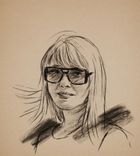
Six months ago, I first came across the videos of Kelly Boesch, a Los Angeles–based artist and songwriter. If you haven't encountered her work yet, it is well worth seeking out.
Take her video for Not Made for the Cage. It's an anthem to freedom and to being different, a rebellion against being forced to fit a single mold. Music and visuals weave together into living dreams of free human souls straining against the cage of the ordinary world. In these short, surreal videos, giant flowers give way to alien landscapes, and you simply can't look away.
Boesch spent twenty years in design — including at IMAX, the company behind the technology and films made for giant cinema screens — and today she works alone, making art with AI. She creates images in Midjourney, animation in Runway, Pika, and Veo, and music in Suno; she writes the lyrics herself. The results are looping videos with no beginning and no end, like paintings brought to life. They rack up around 60 million views a month.
The gatekeepers that used to stand between Boesch's work and her audience have vanished. Galleries and selection committees no longer decide what the public can see. All that remains is the subscription and the feed.
2. The same tool
Of course, easy access to AI tools more often yields an entirely different kind of content. One of the most popular AI channels on YouTube, for example, is India's Bandar Apna Dost ("Monkey, My Friend"). It features a strikingly realistic AI-generated monkey that keeps landing in everyday human situations. Since its launch, the channel has drawn 2.4 billion views. The video-editing platform Kapwing estimates its potential earnings at around $4.25 million a year.
There are hundreds of content factories like it. After screening 15,000 popular channels, Kapwing's analysts found nearly 300 accounts filled with nothing but AI slop. Together, the videos on these channels draw 63 billion views and roughly $117 million in potential ad revenue a year. On the scale of the global market, the figure isn't staggering, but, as journalist Max Read told The Guardian, such channels are most often run from Ukraine, India, Kenya, Vietnam, Nigeria, or Brazil, where even a tiny slice of that revenue amounts to a serious income.
Boesch and the makers of the AI monkey use the same tools, yet viewers spot the difference between their work instantly.
3. Artificial selection
The rules of the game are still taking shape. Every platform and every country has its own regulations, but none yet distinguishes a masterpiece from trash: they judge anything produced with AI the same way. The main challenge for artists working in this new genre is simply reaching an audience.
YouTube CEO Neal Mohan pledged to crack down on low-quality AI content in January 2026. Soon afterward, 16 channels from Kapwing's list (which had jointly amassed 4.7 billion views) disappeared or were stripped of their videos. YouTube still permits AI, however; its rules withhold monetization only from content that is "mass-produced, generic, repetitive, or manipulative."
The site never explained exactly where that line falls. After the purge, ordinary faceless channels — where the creator never uses AI, just doesn't appear on camera — began complaining of collapsing reach. The monkey, meanwhile, carried on.
It was on Bandcamp that Boesch learned what anti-AI policies mean for an artist. In January 2026, the platform for independent musicians banned music made wholly or in substantial part by AI, and one morning Boesch's catalog simply vanished, giving her no warning, no explanation, and no way to reach the thousands of people who had already purchased her songs.
Technically, the ban followed the rules: a machine generated Boesch's sound. It didn't matter that the lyrics, the visuals, and the mix were her own. The rule looks at the method, not the artist.
Distribution once merely delivered the work; critics and audiences judged it. Now distribution itself determines whether art reaches the public at all. At Bandcamp, no one bothered to weigh the worth of Boesch's songs. They just removed them under the platform's revised rules, with no regard for the choice of the many people who had bought them.
Platforms aren't alone in these sweeping decisions. In Europe, Article 50 of the EU's AI Act has applied since August 2, 2026: AI-generated content must be labeled, and after that it's up to the viewer.
Labeled slop is legal in Europe. In China, the state decides for itself: in 2026, regulators removed more than 5.6 million pieces of AI content deemed illegal or in violation of the rules.
Video platforms look for a face on screen; governments demand labels or order removals. Both are mere technicalities. Nobody cares about the artist.
4. The institutions' choice
For curators and art institutions, AI art is long since old news: it's appeared at biennials and major galleries for years.
This summer, the Palazzo Cini in Venice showed new paintings by David Salle, one of the 1980s' foremost American painters. He trained his own model on his "tapestry" paintings of 1989–1991, then worked over its output in oil and charcoal. Salle's explanation is straightforward: the material had been waiting a long time, and the machine let him move quickly.
Holly Herndon and Mat Dryhurst — she American, he British — live and work in Berlin. They trained a model on distorted images of Herndon herself and presented it at the 2024 Whitney Biennial in New York. No matter the prompt's specifics, the machine returned an uncanny version of Herndon. In this way, the artist herself decided how AI models would see her.
Refik Anadol, born in Istanbul and based in Los Angeles, trained a model directly on the collection of New York's Museum of Modern Art (MoMA); his project Unsupervised played in the museum's lobby for nearly a year.
In all three cases, the machine works with material the artist controls: their own paintings, their own face, or a museum's collection. For the curator, that answers the central question: whose work is this? Here the model seems to extend the artist's hand.
Artists like Boesch take a fundamentally different path. They have no custom-built model of their own; they work in apps available to millions. Institutions view this with suspicion: it seems that a mass-market tool yields a mass-market style.
Therein lies the Boesch paradox: she achieves complete distinctiveness precisely where the tool pulls everything toward the average. Among millions of generated clips, her work is unmistakable from the very first frames.
What's more, biennials and major museums plan exhibitions two to three years in advance. What hangs in Venice today was selected back in 2024, long before powerful video generators like Google Veo 3 appeared. If, a couple of years from now, someone wants to show what cutting-edge AI art looked like today, they won't find it in museum storerooms but in social media feeds.
5. The lesson of photography
The argument about accessible tools has been made before. In 1859, Charles Baudelaire called photography a refuge for failed painters. In 1888, Kodak released its first consumer camera, with the slogan "You press the button, we do the rest." Its 1900 Brownie cost only a dollar, truly letting anyone take a photo. For decades, this remained the chief argument against photography as art: if anybody can press the button, where is the artist?
Over time, though, the world learned to tell a photographer from someone who simply owns a camera. Alfred Stieglitz spent decades fighting for photography to be recognized as art, and in 1940 MoMA opened the world's first museum department of photography.
Today, cameras are more accessible than ever. Every phone has a lens, and everyone takes photographs, but still only a few make art.
With AI tools, we haven't reached that stage yet. The new digital art still lacks any shared framework for telling an endless flood of generated cookie-cutter content apart from the singular, one-of-a-kind work of a master.
6. How to spot the artist
Every day we see audiences single out strong AI artists unerringly, without any methodology at all. Their choices reveal the criteria they use: the same ones that apply to any other art form.
The first is recognizability. The monkey from Bandar Apna Dost is recognizable from the first second, but as a template. I recognize Boesch's videos before I see her name.
The second is the artist's choices. A prompt sets a process in motion, but the result becomes a work of art only after selection, editing, and many other decisions.
The third is consistency. A unified style and signature carry through from one work to the next, rather than dissolving into scattered lucky breaks.
None of these three criteria has anything to do with tools. All three are about the artist's presence, taste, and ideas. Unfortunately, no platform filter can pick those up.
You can hide your face, but you can't hide your voice. Perhaps that is the true mark of art, with AI or without it: behind the work, you can hear the artist.
While curators prepare exhibitions in which AI serves as co-author, the most vital art is being made right now on social media. Platforms today only have to let it reach its audience.
A new genre, born of AI tools available to anyone, will take shape regardless of platforms and regulators. It is already art — and who the real artists are is for us, the viewers, to decide.
Sources
References cited in this piece. Last verified on the published or revision date.
- 01
- 02
- 03
- 04
- 05
- 06
- 07
- 08
- 09
- 10
- 11
- 12
- 13
- 14
- 15
- 16
- 17
- 18
- 19
- 20
- 21